Psychology & Cinema Series: A Clockwork Orange, Psychopathy, and the Problem of “Curing” Evil
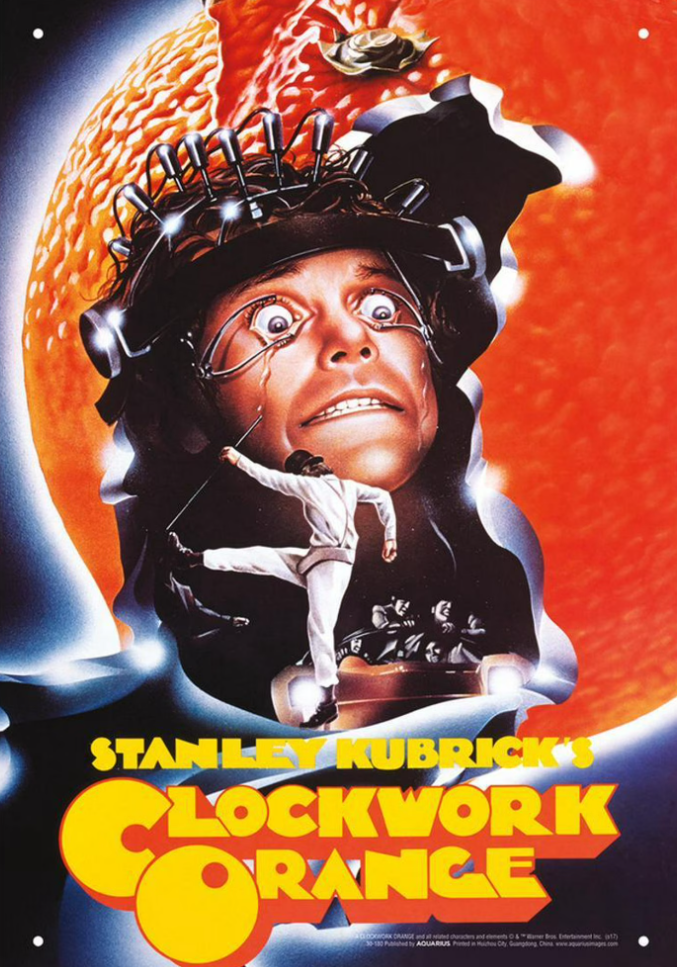
Every once in a while, a film comes along that is not just memorable, but psychologically unsettling in a way that sticks with you. A Clockwork Orange, directed by Stanley Kubrick (1971) and based on Anthony Burgess’s (1962) novel, is one of those films for me. It is one of my favorite movies, and also one of the most difficult to watch.
Before going any further, it is worth saying this clearly: this is an extremely vicious film. It is sexually violent, psychologically disturbing, and intentionally provocative. When it was released in 1971, it received an X rating for the sex and violence, which at the time was unheard of for a film that would go on to receive an Academy Award nomination for Best Picture. It was banned in multiple countries for decades and considered fringe, even as it as consistently been reviewed as one of the best films ever made.
That said, from a psychological perspective, it is fascinating. It touches on psychopathy, behavioral conditioning, free will, ethics, and even developmental criminology in ways that are surprisingly sophisticated. It is one of those rare films where you can pause almost any scene and turn it into a lecture.
The World of Alex: Violence as Identity
The film is set in a dystopian version of England, one that feels vaguely futuristic but also strangely familiar (as most retro-futuristic things are to me). Society is stagnating, seemingly timid and at prey to heavy political turmoil, and is overwhelmed by crime, with much of that crime being driven by roving gangs of young hoodlums. Notably, the film suggests that the gangs dress in bizarre costumes that are the ‘style of youth’, a lot like The Warriors in my opinion (a future movie for this series!).
At the center of the story is Alex DeLarge, played by Malcolm McDowell in what I would argue is one of the most chilling performances in film history. Alex is the leader of a small gang of ‘droogs’ (Russian for ‘friend’, used in the film as a futuristic and strange slang), and he spends his nights engaging in what he calls “ultraviolence”: brutal assaults, sexual violence, and random acts of cruelty. What makes Alex particularly disturbing is not just what he does, but how he experiences it. He takes joy in it. He treats violence almost like art, pairing it with classical music and theatrical flair.
Alex as a Psychopath: Charm, Cruelty, and Emotional Emptiness
From a psychological standpoint, Alex is a near textbook depiction of a psychopath, even though the film predates much of the modern research language we use today. If you think back to our discussions of psychopathy, especially through the work of Robert Hare and the Psychopathy Checklist Revised (PCL-R), Alex hits many of the key traits. He shows a profound lack of empathy. He is impulsive, thrill seeking, and completely unconcerned with the suffering of others. He lies easily, manipulates people around him, and often presents himself as a victim when it suits him.
What stands out most is the emotional quality, or lack of it. Alex does not just commit violent acts. He seems emotionally detached from them in a way that feels hollow. His reactions are either exaggerated for effect or eerily flat. This is consistent with what research describes as shallow affect, where emotional expressions are present but lack genuine depth (Hare, 2003). But he is also quite charming and witty when he wants to be, brimming with confidence and invulnerability. These are traits that psychopaths use to disarm their victims, luring them closer to being exploited by the monster.
There is one scene that I always come back to when thinking about psychopathy. After being arrested, Alex is brought into a police station and beaten by officers. His social worker, who knows his history and the only person to initially see through Alex’s façade, comes to see him. Alex is crying, pleading, acting weak and helpless. Then the social worker, clearly disgusted, spits in his face.
In that moment, everything changes. The crying stops instantly. His expression hardens. He looks up and smirks with a frightening gleam in his eye.
It is a brief moment, but it is incredibly revealing. The performance drops, and you see something colder underneath. I try to describe that moment as what psychopathy actually looks like. It is not just violence but wearing a mask of sanity (Checkley, 1941) that betrays the gleeful thrill of hurting other people.
In 2001, Rob Zombie (a grindhouse film lover as well as musician) wrote a song inspired by the film, “Never Gonna Stop (The Red, Red Kroovy)”. In addition to loving the song, I always thought one of the refrains not only captures Alex perfectly, but encapsulates the brutal nature of a violent, sexual psychopath: “Scream if you want it/ Cause I want more”
If we apply the Dark Triad framework, Alex becomes even more interesting. The Dark Triad consists of three overlapping but distinct personality traits: psychopathy, narcissism, and Machiavellianism (Paulhus & Williams, 2002). We have already talked about psychopathy, and Alex clearly fits that profile. But he also shows strong elements of the other two.
There is a narcissistic component in the way he views himself. Alex sees himself as exceptional. His use of language, his love of classical music, and his theatrical presentation of violence all suggest a sense of superiority. He sees himself as refined, almost artistic in his brutality. In his daydreams he envisions himself as a king, a general, a god that women throw themselves at. Alex does not see himself as just another delinquent, he is the lord and master over the older boys in his gang, tolerating no dissent.
At the same time, there is a Machiavellian element in how he navigates systems. Later, when Alex is in prison, he quickly learns how to present himself as reformed. He adopts religion, participates in approved activities, and performs compliance, all as a strategy to gain early release. This is not genuine change, it is calculated self-presentation.
What makes Alex particularly dangerous, and particularly compelling as a character, is how these traits combine. The impulsivity and emotional detachment of psychopathy, the self-importance of narcissism, and the strategic manipulation of Machiavellianism all reinforce each other. This is why the Dark Triad framework is so useful in looking violent offenders move. It helps us see that these traits are not isolated. They interact, and when they do, they create a personality style that is both socially functional and deeply harmful.
The Ludovico Technique: Behavioral Psychology Turned Nightmare
The second major psychological theme in the film is the treatment Alex undergoes after being sentenced to prison. Desperate to secure early release, he volunteers for an experimental procedure called the Ludovico Technique.
This is where the film leans heavily into behavioral psychology, particularly classical conditioning. If you remember Pavlov’s dog, the idea is that you can pair a neutral stimulus with a meaningful one until the neutral stimulus begins to produce the same response. Over time, associations form automatically. With Pavlov’s dog, a bell was rung every time food was presented. Eventually, just hearing the bell would cause the dog to drool simply in anticipation of the food (that may never come). In therapy, similar principles are used in exposure-based treatments, where individuals learn to associate feared stimuli with safety rather than danger, or even more extreme with aversion therapy where a painful or upsetting stimuli is given with a behavior to diminish it (Craske et al., 2014).
The Ludovico Technique is essentially a dark inversion of this idea.
In the film, the “Ludovico Technique” is a form of aversion therapy designed to curb Alex’s violent impulses and make him a “good person”. Alex is strapped to a chair with his eyes forced open and made to watch films of extreme violence, sexual assault, and war atrocities. Normally, Alex would greatly enjoy such horrific scenes, but he is injected with a drug that induces intense nausea, panic, and physical distress. This horrible feeling occurs as he’s watching the scenes of violence, and, over repeated sessions with him screaming in pain, he begins to associate violence with overwhelming sickness and fear. Eventually, the association between pain and violence is so strong that even the thought of violence triggers this reaction. Alex becomes physically incapable of acting on his impulses without becoming incapacitated, as demonstrated at his ceremony that pronounces him “cured” of his evil.
From a purely theoretical standpoint, this is an exaggerated version of aversion therapy, which has existed in various forms. Historically, treatments like disulfiram for alcohol use disorder attempted to create negative physical reactions to substance use hopefully to condition an alcoholic to avoid alcohol (to be fair, it doesn’t work very well) (Wright & Moore, 1990). But the film takes this idea to an extreme, raising important questions about both effectiveness and ethics.
Is He “Cured”? Behavior Versus Intent
After the treatment, Alex is presented as rehabilitated. In a demonstration, he is insulted, humiliated, and even physically threatened, but he cannot respond with aggression. When he tries, he becomes violently ill.
On the surface, this looks like success. The violent behavior is gone. But when you look more closely, something important becomes clear. Alex’s desires have not changed. In the demonstration of the Ludovico Technique’s effectiveness, as Alex is being insulted, he tries to fight but then is instantly incapacitated by the resulting pain. Immediately after this, a naked woman appears on stage and, though Alex certainly knows what will happen, he still reaches to grope her, only to again be struck with pain and nausea as the audience claps. But nothing really has changed. Alex still wants to harm others. He still experiences the same impulses. The only difference is that he is now physically prevented from acting on them.
This raises a critical psychological and philosophical question. What does it mean to be a good person? This is something I talk about a lot in my Psychology of Evil class. Is morality about behavior, or is it about intention?
The prison chaplain in the film voices this concern directly. He argues that if a person is incapable of choosing evil, then their apparent goodness has no moral value. They are not choosing to be good. They are being forced into it.
This distinction matters in real world contexts as well. We see similar debates in discussions of chemical castration for sexual offenders, or pharmacological interventions that reduce aggression, or even older interventions like lobotomies. If the behavior is controlled but the underlying desire remains and/or the real principle of free will has been eliminated, what exactly has been changed and how is this better?
The film suggests that we have not eliminated violence. We have simply suppressed it.
Another consequence of the Ludovico Technique is something we often overlook at first. Alex does not just lose the ability to commit violence. He loses the ability to defend himself. The world he is a part of (and likely created him) is a violent one. Here, the tiger has lost his teeth. In one scene, he is attacked and cannot fight back. In another, he is humiliated and degraded without resistance. Even sexual arousal becomes linked to illness, stripping away his autonomy in multiple domains.
This highlights a key limitation of behaviorally focused interventions. When you target behavior without addressing underlying cognition, emotion, and context, you may create new vulnerabilities. Alex is not safer; he is more fragile.
Free Will, Responsibility, and the Ethics of Control
At its core, A Clockwork Orange is a film about free will. Burgess himself described it as a story about the importance of choice. The title refers to something organic turned mechanical, a human being stripped of agency and reduced to a predictable system. Thus, Alex is like a ‘clockwork orange’, an organic robot that is wound up to move the way we want it to (I didn’t come up with that, that’s from Burgess).
From a psychological perspective, this connects to long standing debates about determinism and responsibility. If behavior can be controlled through conditioning, to what extent are individuals responsible for their actions? And if we remove the capacity for harmful behavior, do we also remove something essential about being human?
The film does not offer easy answers. Instead, it forces the viewer to sit with the discomfort of these questions.
The Ending That Changes Everything
One of the most interesting differences between the novel and the film is the ending. The American version of the book, which Kubrick used, ends with Alex returning to his violent tendencies after the effects of the treatment are reversed. As soon as the guardrails are removed, Alex is back to being a brutal psychopath (“I was cured alright”).
But the original British version includes an additional chapter.
In that final chapter, Alex is older. He encounters former friends who have moved on with their lives. For the first time, he reflects. He begins to feel a kind of emptiness in his previous lifestyle. He imagines a different future, one that does not involve violence. Importantly, this shift is not forced, it is chosen.
From a developmental psychology perspective, this is incredibly significant. Research consistently shows that violent behavior tends to peak in adolescence and early adulthood and declines with age, a pattern known as the age crime curve (Farrington, 1986). Even individuals with serious antisocial behavior often reduce their offending over time. This does not mean everyone changes. But it does challenge the idea that people are permanently fixed in their worst moments.
Juvenile Offending, Psychopathy, and the Myth of the “Super Predator”
This connects to another important theme. In the 1980s and 1990s, there was a widespread belief in the idea of the juvenile super predator, a young offender who was supposedly irredeemable and destined for lifelong violence.
Research has not supported this idea.
Adolescents are more impulsive, more emotionally reactive, and more influenced by their environments. Their brains, particularly the prefrontal cortex, are still developing, which affects decision making and impulse control (Steinberg, 2008). As a result, many young offenders “age out” of crime as they mature. Even in the study of psychopathy, there is evidence that traits can shift over time, especially in younger populations. Scores on measures like the PCL-R are more stable in adulthood but less so in adolescence, as in if you score a 31 at age 25, you’ll likely still be a 31 at 48. But people under age 25, there’s variance and sometimes decrease in scores. This suggests that early intervention and environmental factors can make a difference.
If we think about Alex as a fifteen-year-old, his portrayal as a fully formed, unchangeable psychopath may be more cinematic than realistic. Certainly, we like movie monsters like Alex, the same way we like Michael Myers or Freddie Kruger. But, that’s not real life (even if there are some monsters here). The novel’s original ending, where Alex grows and changes, may actually be closer to what we see in real developmental trajectories.
Why This Film Still Matters
A Clockwork Orange remains relevant because it forces us to confront uncomfortable truths about human behavior. It asks whether we value safety over autonomy, whether we can separate behavior from identity, and whether it is possible to eliminate violence without losing something essential in the process. It also serves as a powerful teaching tool. It brings together psychopathy, behavioral conditioning, ethics, and developmental psychology in a way that is accessible and emotionally impactful.
I still have a movie poster I received as a gift hanging in my home office (which raises some questions I suppose). Personally, it is one of those films that I keep coming back to, both as a viewer and as an educator. It sits in that space where psychology, philosophy, and art intersect, and it refuses to give you clean answers. If you decide to watch it, watch it critically. Pay attention not just to what Alex does, but how the system responds to him. Ask yourself whether he changes, or whether he is simply controlled.
And then ask the harder question. If you could eliminate violence by removing choice, would you do it?
References
Burgess, A. (1962). A Clockwork Orange. Heinemann.
Craske, M. G., Treanor, M., Conway, C. C., Zbozinek, T., & Vervliet, B. (2014). Maximizing exposure therapy. Behaviour Research and Therapy, 58, 10–23.
Cleckley, H. (1941). The mask of sanity. Mosby.
Farrington, D. P. (1986). Age and crime. Crime and Justice, 7, 189–250.
Hare, R. D. (2003). Without conscience: The disturbing world of the psychopaths among us. Guilford Press.
Kubrick, S. (Director). (1971). A Clockwork Orange [Film]. Warner Bros.
Steinberg, L. (2008). A social neuroscience perspective on adolescent risk taking. Developmental Review, 28(1), 78–106.
Wright, C., & Moore, R. D. (1990). Disulfiram treatment of alcoholism. The American journal of medicine, 88(6), 647–655. https://doi.org/10.1016/0002-9343(90)90534-k
