The Dark Triad and the Psychology of Dangerous Personalities
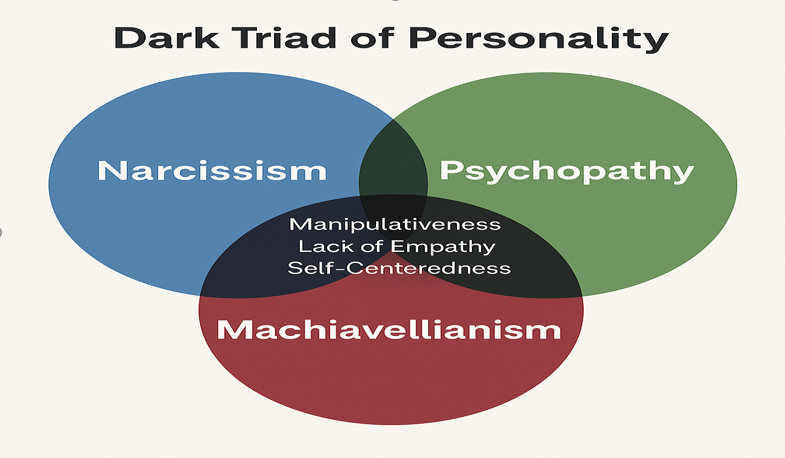
Paulhus & Williams, 2002
In a previous post, I wrote about psychopathy. We covered the history, the myths, the diagnostic debates, and the uncomfortable reality that psychopathy is one of the strongest personality predictors of persistent antisocial behavior. But, according to some theorists, psychopathy does not exist in a vacuum. If we want to understand how psychology intersects with the legal system, especially in matters of violence, exploitation, and criminal risk, we need to widen the lens.
So, this is part two. Today I want to talk about what researchers have called the Dark Triad of personality.
The term was coined by Delroy L. Paulhus and Kevin M. Williams in a 2002 paper that examined three socially aversive personality traits: narcissism, Machiavellianism, and psychopathy (Paulhus & Williams, 2002). The basic idea was simple but provocative. These three traits are overlapping but distinct. Each carries interpersonal risk. When they cluster together in one person, the potential for harm increases.
In forensic psychology, that matters.
Let us take them one at a time.
Narcissism: Entitlement Without the Diagnosis
When we talk about narcissism in this context, we are not necessarily talking about Narcissistic Personality Disorder (NPD). That is a clinical diagnosis with specific criteria, including grandiosity, entitlement, fragile self-esteem, hypersensitivity to criticism, and what we call narcissistic injury. That disorder can be debilitating and complex. Additionally, while we tend to think about the damage these behaviors cause to other people, it is worth noting that people with NPD are actually in a great deal of emotional pain.
NPD isn’t what we are talking about. Here, we are talking about narcissistic traits. Elevated self-importance. A sense of superiority. Belief that one deserves special treatment. A tendency to dismiss or devalue others when admiration is not forthcoming.
Culturally, we throw around the word narcissist constantly. It has become shorthand for “self-absorbed person I do not like.” But in personality research, narcissism exists on a continuum. Many people have some degree of it. In moderate doses, it can even be adaptive. Confidence, ambition, and social boldness often overlap with narcissistic features. The problem arises when entitlement and self-focus override empathy and reciprocity. When admiration becomes a need rather than a preference. When criticism becomes an attack. That is when narcissistic traits start creating real interpersonal damage.
Research using the Narcissistic Personality Inventory shows that subclinical narcissism is associated with extraversion and openness, but also low agreeableness and self enhancement biases (John & Robins, 1994; Paulhus, 1998). Narcissists often genuinely believe they are smarter or more capable than objective measures would suggest. That distortion is not always malicious, but it can shape behavior in high stakes contexts, including leadership, corporate settings, and sometimes criminal justice encounters.
Psychopathy: Callousness and the Absence of Remorse
We have already spent time on this in class and in my earlier post. Psychopathy is characterized by low empathy, shallow affect, impulsivity, callousness, and critically, a lack of remorse or guilt. It is not just low empathy. Empathy itself exists on a continuum. As Simon Baron-Cohen (2011) has argued, very low empathy can be associated with a range of conditions, including autism spectrum presentations, which do not inherently involve malicious intent. What distinguishes psychopathy is the absence of remorse for harming others combined with instrumental or predatory tendencies.
Psychopathy is most rigorously measured with tools like the Psychopathy Checklist Revised developed by Robert D. Hare (1991). In forensic settings, high psychopathy scores are associated with recidivism, institutional misconduct, and violent reoffending. That is why the construct is so central in criminal risk assessment. With that being said, Hare’s conceptualization of psychopathy in the PCL-R is but one of the theories of the various aspects of the disorder. In the context of the Dark Triad, however, psychopathy is quite broad.
Machiavellianism: Strategic Manipulation
Finally, we have the third member of the triad, and the one people are often less familiar with: Machiavellianism.
The construct of Machiavellianism originated in the work of Richard Christie and Florence Geis in the 1970s (Christie & Geis, 1970). It reflects a manipulative, strategic, and power oriented interpersonal style. High Machiavellian individuals are calculating. They think several moves ahead. They are comfortable deceiving others if it serves their goals. They are less impulsive than psychopaths and often more patient. Individuals with high Machiavellianism are always assessing how they can bend someone towards their will, or how they can take advantage of them. If narcissism is self-centeredness and psychopathy is callousness, Machiavellianism is manipulation.
In everyday life, high Machiavellianism might show up as political maneuvering, corporate gamesmanship, or calculated social positioning. It does not automatically imply violence. In fact, some Machiavellian individuals function quite effectively in competitive environments (such as politics and cut-throat corporations). But in combination with low empathy and grandiose entitlement, the manipulative capacity becomes far more concerning.
Are They the Same Thing?
Paulhus and Williams asked whether these three traits were essentially the same thing in different clothing. Their data suggested no. The traits were moderately correlated with each other but clearly distinct, most especially with their relationship to other personality traits. The classic personality trait theory of the Big Five proposes that human personality can be described across five broad dimensions: openness to experience, conscientiousness, extraversion, agreeableness, and neuroticism. These traits are relatively stable over time, biologically influenced, and predictive of behavior, emotional functioning, and life outcomes across cultures (John & Srivastava, 1999) The only consistent Big Five personality overlap across all three of the Dark Triad traits was low agreeableness (Paulhus & Williams, 2002). Psychopathy also showed uniquely low neuroticism, consistent with the classic portrayal of the fearless, low anxiety offender. Narcissism was linked with extraversion and openness. Machiavellianism and psychopathy were associated with lower conscientiousness. Each trait has its own personality fingerprint. That is important because at the core of the Dark Triad lies antagonism.
When the Traits Cluster
Assuming personality traits are predictive of behavior, traits shape behavior long before a crime is committed. They shape how someone responds to authority, how they interpret social cues, how they justify harmful actions, and whether they experience remorse. In risk assessment, we are rarely interested in one trait in isolation. We are interested in patterns.
Imagine an individual high in narcissism but low in psychopathy. They may be arrogant and self-focused, but if they retain empathy and guilt, their capacity for sustained cruelty is limited. They might be obnoxious. They might even be exploitative in subtle ways. But they are not necessarily dangerous. Now imagine someone high in psychopathy but low in Machiavellianism. You might see impulsive aggression, poor planning, reactive violence. Harmful, yes. But perhaps less calculated.
Now imagine all three operating together. Grandiose entitlement. Emotional coldness. Strategic manipulation. That is the cluster Paulhus described as particularly concerning. From a forensic perspective, this clustering could inform how we conceptualize certain offenders. Some individuals appear not only callous, but calculated. Not only self-centered, but driven to dominate. Not only lacking remorse, but skilled at impression management. This is the configuration that Paulhus argues is highly destructive: the narcissism fuels self-importance, the psychopathy eliminates guilt, the Machiavellianism provides the strategy.
Personality and Legal Responsibility
This is where the intersection between psychology and law becomes ethically complex. Courts are wary of personality evidence. We do not want to criminalize personality traits. Having high narcissism is not a crime. Being manipulative is not, by itself, illegal. Even psychopathy, absent criminal conduct, is not prosecutable.
Yet personality is relevant to sentencing, supervision decisions, and risk management. When we conduct violence risk assessments, we examine historical factors, clinical features, and risk management variables. Personality traits fall into that clinical domain. The presence of callousness, grandiosity, and manipulativeness can inform how someone might respond to probation conditions, treatment, or institutional rules.
There is also a philosophical layer here. How much responsibility does someone bear if their personality predisposes them toward exploitation or harm? The legal system rests on assumptions of free will and moral agency. Psychology complicates that picture. Traits like psychopathy are associated with atypical emotional processing and reward sensitivity. That does not eliminate responsibility, but it raises uncomfortable questions about blame and prevention.
Avoiding Caricatures
The Dark Triad framework also intersects with research on everyday harm. In Christopher Burris’s (2002) work on the psychology of harming others, the argument is not that evil is rare and monstrous. It is that ordinary personality dynamics can produce cruelty under the right conditions. Low agreeableness combined with self-focus and instrumental thinking can erode moral restraint.
One of the more interesting findings in Paulhus and Williams’ original paper was that narcissists and, to a lesser extent, psychopaths showed measurable self enhancement bias. They overclaimed knowledge and overestimated their intelligence relative to objective measures. Machiavellians did not. That is fascinating. It suggests that narcissism carries a self-deceptive element, whereas Machiavellianism is more reality based, even cynical. In the courtroom, that difference might matter. A narcissistic defendant may genuinely believe in their superiority or victimhood. A Machiavellian defendant may strategically present a version of themselves they know to be advantageous.
As forensic psychologists, we have to disentangle performance from personality. We have to ask whether we are seeing impression management, genuine belief, emotional deficit, or some combination. It is also important not to overstate the Dark Triad. Most people with elevated narcissism are not criminals. Many high functioning professionals score high on certain Dark Triad traits and never commit crimes. Personality traits interact with environment, opportunity, stress, and social learning. They are risk factors, not destiny.
Still, the model gives us a useful language for thinking about certain patterns of harmful behavior. It reminds us that violence is not always impulsive rage. Sometimes it is cold, strategic, and ego driven. Sometimes harm is inflicted not out of desperation but out of entitlement and domination.
Conclusions
I do not think that the Dark Triad represents a new kind of offender, rather just a different perspective of violence. It is not a diagnostic category. It is a descriptive framework. But it does encourage us to look beyond psychopathy alone. If psychopathy is one leg of the stool, narcissism and Machiavellianism may stabilize it. The intersection between psychology and the legal system is rarely clean. Courts want categories. Psychology deals in continua. The Dark Triad exists on continua. People vary in degree, not kind.
What this research ultimately reinforces for me is that the most dangerous personalities are not always the most dramatic, but they are often the most antagonistic. Low agreeableness may not sound cinematic, but it reflects a fundamental disregard for others’ needs. Combine that with entitlement and strategic manipulation, and you have a constellation that can produce real harm.
As we continue exploring forensic psychology, I want you to keep that complexity in mind. We should avoid caricatures; avoid assuming that one trait explains everything. And remember that personality is part of the story, but never the whole story.
References
Baron-Cohen, S. (2011). The science of evil: On empathy and the origins of human cruelty. Basic Books.
Burris, C. T. (2022). Evil in mind: The psychology of harming others. Oxford Press.
Christie, R., & Geis, F. L. (1970). Studies in Machiavellianism. New York: Academic Press.
John, O. P., & Robins, R. W. (1994). Accuracy and bias in self-perception: Individual differences in self-enhancement and the role of narcissism. Journal of Personality and Social Psychology, 66(1), 206–219. https://doi.org/10.1037/0022-3514.66.1.206
John, O. P., & Srivastava, S. (1999). The Big Five trait taxonomy: History, measurement, and theoretical perspectives. In L. A. Pervin & O. P. John (Eds.), Handbook of personality: Theory and research (2nd ed.., pp. 102–138). New York: Guilford.
Paulhus, D. L. (1998). Interpersonal and intrapsychic adaptiveness of trait self enhancement: A mixed blessing. Journal of Personality and Social Psychology, 74 (5) 1197- 1208. https://doi.org/10.1037/0022-3514.74.5.1197
Paulhus, D. L., & Williams, K. M. (2002). The Dark Triad of personality: Narcissism, Machiavellianism, and psychopathy. Journal of Research in Personality, 36 (6), 556 -563. https://doi.org/10.1016/S0092-6566(02)00505-6
Hare, R. D. (1991). The Hare Psychopathy Checklist Revised. Toronto: Multi Health Systems.
