The Insanity Defense: Madness, Morality, and the Law
Every semester when I cover the insanity defense in my forensic psychology class, I tell my students that this is where psychology and the law truly collide. The insanity defense sits right at the intersection of medicine, philosophy, and justice; it’s about as “forensic psychology” as it gets. At its core, it forces us to ask a deeply uncomfortable question: when someone commits a terrible crime, under what circumstances should we not hold them morally or legally responsible?
The foundation of our legal system is that we punish people who are guilty. Justice requires both accountability and fairness. So, what do we do when someone has committed an act that is clearly criminal, but did so while experiencing a severe mental illness that robbed them of control or understanding? Are they guilty? Should they be punished in the same way as someone who acted with intent and awareness?
This debate is not new, it stretches back thousands of years, but it began to crystallize within the English legal system, from which modern American law descends. To understand the insanity defense today, it helps to see where it came from, what it means in theory, and how it actually works in practice.
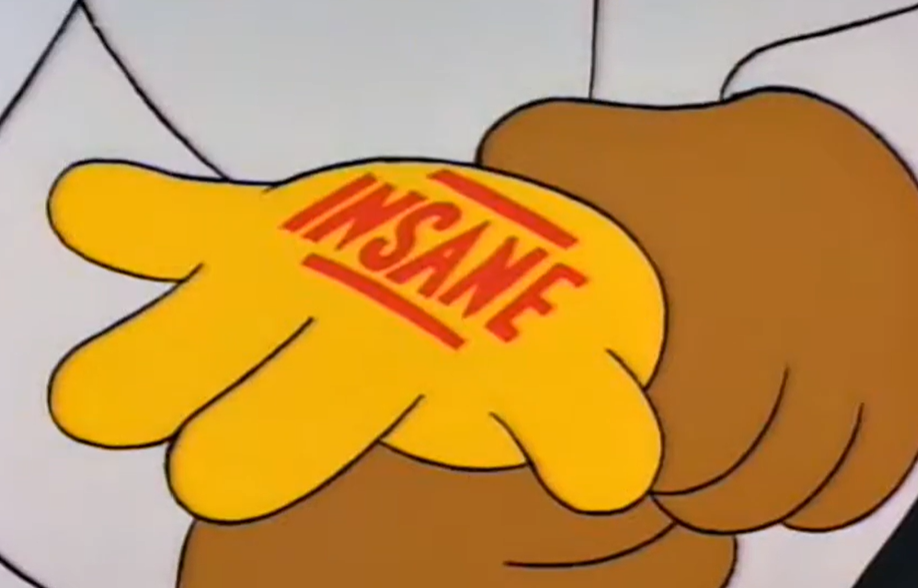
“Whoever has that stamp on his hand is insane
Setting the Stage: Why Insanity Matters
Before diving into the history, let’s clarify what the insanity defense is not. It’s not about whether a person currently has a mental illness, and it’s not about whether they can stand trial. That’s competency. Competency concerns a defendant’s present ability to understand court proceedings and assist in their own defense. Insanity, on the other hand, is retrospective: it asks what the person’s mental state was at the time of the crime.
And it’s not the same as civil commitment either. Civil commitment is a civil, not criminal, matter. It’s about whether a person poses a danger to themselves or others and can be held for treatment. Insanity, in contrast, is a legal defense that may excuse someone from criminal responsibility altogether.
Here’s the key distinction: insanity is not a diagnosis in the DSM-5. You can’t be stamped “insane” by a psychiatrist. It’s a legal label, determined by courts, based on legal standards, standards that often rely on expert testimony from psychologists and psychiatrists. These experts testify about the defendant’s mental state, but the ultimate question, whether that state meets the legal definition of insanity, is one for the jury to decide.
Why the Law Cares About Mental State
The entire idea of criminal responsibility hinges on two things: actus reus (the guilty act) and mens rea (the guilty mind). To be guilty of a crime, you have to do something illegal and intend to do it. If I accidentally bump into someone and they fall, I haven’t committed battery. If I deliberately punch them, that’s assault. But if I throw a punch because I’m in the throes of a psychotic episode and believe the person is a demon trying to kill me, what then? Did I really possess a “guilty mind”?
The insanity defense stems from this principle: if someone lacks the capacity for mens rea, they cannot be held criminally responsible. As early as the Roman Empire, legal thinkers recognized that people “without mastery of mind” should not be punished for crimes. By the Middle Ages and Renaissance, English courts and theologians framed this through the moral lens of good and evil. If a person was so mentally ill that they could not distinguish good from evil or right from wrong, they could not be held culpable. This often applied to children during their “age of innocence”, but also applied to senility and “madmen”.
The Wild Beast Test: The First Modern Standard
Our modern insanity defense traces back to an 18th-century English case, Rex v. Arnold (1724). Edward Arnold had attempted to kill a nobleman Lord Onslow, claiming that the man was bewitching him by sending demonic imps to torment him. The prosecution argued that Arnold was a normal, but foul-mouthed, person that wasn’t a ‘mad’ but rather a crude and evil man. His defense argued that he was a madman who lacked control over his actions. The judge, Lord Tracy, told the jury that to be insane, a person must be “totally deprived of their understanding and memory, and not know what they are doing any more than an infant, a brute, or a wild beast.” Hence the “wild beast” test was born.
This test was incredibly strict. It wasn’t enough to have delusions, odd behavior, or erratic thoughts. A person had to be so profoundly impaired that they essentially lacked humanity, like an infant or an animal. Not surprisingly Arnold didn’t meet that bar and was found guilty. He was sentenced to death, but the King commuted his sentence and he was imprisoned for the rest of his life.
But the precedent stuck. The wild beast test framed insanity as a complete absence of reason, a total loss of understanding of right and wrong. This view fits with the retributive logic of criminal punishment. If punishment exists to balance moral scales and deter wrongdoing, punishing someone who has no capacity to comprehend moral meaning is nonsensical. A madman cannot be “taught a lesson.” They cannot learn from punishment, nor does punishing them deter others who act under delusion. The wild beast test remained influential for over a century, setting the philosophical groundwork for all insanity defenses that followed.
The M’Naghten Rule: The Bedrock of Modern Insanity
One of the most famous insanity cases in history came in 1843: Daniel M’Naghten’s Case. M’Naghten, suffering from what we’d now call paranoid schizophrenia, believed the British Prime Minister’s government was conspiring against him. Attempting to kill the Prime Minister, he shot and killed the wrong man, a secretary named Edward Drummond.
At trial, medical experts testified that M’Naghten’s delusions drove his actions. The jury found him not guilty by reason of insanity, sparking a massive public outcry. Queen Victoria herself demanded reform.
In response, the House of Lords crafted what became known as the M’Naghten Rule to guide future insanity cases. It stated:
“Every man is presumed to be sane... To establish a defense on the ground of insanity, it must be clearly proved that, at the time of committing the act, the party accused was laboring under such a defect of reason, from disease of the mind, as not to know the nature and quality of the act he was doing; or, if he did know it, that he did not know he was doing what was wrong.”
This test has two key components (the ‘and’ and ‘or’ are important here):
The defendant must have a mental disease or defect; and
Because of that condition, they either didn’t understand what they were doing, OR didn’t understand that it was wrong.
The M’Naghten standard is in many ways a natural outgrowth of the wild beast standard. It recreates the cognitive prong in insanity defense rules, as in it focuses entirely on thought, not impulse or control. You could know something was wrong but still be unable to resist doing it, and under M’Naghten, you’d still be guilty. It was (and still is) a conservative standard that was widely enacted in the United States. Even today, many U.S. states use some form of M’Naghten as their insanity test. It’s the foundation upon which the other, more liberal tests were built in response.
The Irresistible Impulse Test: When Willpower Fails
As psychology evolved, courts began recognizing that mental illness can impair not only cognition but also volition, our ability to control our actions. The ‘irresistible impulse test’ emerged in the 19th century to address that problem. Under this standard, a person could know an act was wrong, yet still be insane if they were unable to resist the impulse to commit it.
Of course, that raises tricky questions. How do you tell the difference between an impulse that was irresistible and one that was merely not resisted? This ambiguity made the standard controversial. On the one hand, almost nothing is a true “irresistible impulse”, with the exception of bodily functions such as sleep and breathing, making this standard impossible to prove. But other critics argued that almost any act could be framed as an “impulse” if you looked hard enough, while still others pointed out that it’s nearly impossible for juries to imagine the subjective experience of a mentally ill defendant. The classic metaphor is the “policeman at the elbow” test: if a police officer were standing beside you and you still couldn’t stop yourself, the impulse was truly irresistible. But even that fails often, as it did with the case of Jeffery Dahmer. Still, the irresistible impulse or volitional prong was included in increasing insanity defense statues in the Untied States.
The Durham Rule: The Product of a Mental Disease
In 1954, Judge David Bazelon of the U.S. Court of Appeals for the D.C. Circuit introduced an even broader approach: the Durham Rule, also called the “Product Test.”
According to Durham v. United States (1954), “an accused is not criminally responsible if his unlawful act was the product of mental disease or mental defect.” This was revolutionary as it placed mental illness squarely at the center of criminal responsibility. But it quickly proved unworkable. Almost any behavior could be argued to be the “product” of a mental illness, and juries were left to rely almost entirely on expert testimony. By the 1970s, the same court that had adopted Durham abandoned it.
The ALI Standard
Created by the American Law Institute’s update to the Moral Penal Code recommendations, the ALI Standard attempted to create a middle ground by combining M’Naghten’s cognitive focus with the volitional element of irresistible impulse. It states that a person is not criminally responsible if, at the time of the act, “as a result of mental disease or defect, they lack substantial capacity either to appreciate the criminality (wrongfulness) of their conduct or to conform their conduct to the requirements of law.”
Under this standard, the presence of mental illness alone was not enough to meet this standard; the illness in question had to be directly connected to the criminal activity (“if not for the illness” the crime would not have happened). Additional restrictions were placed on the ALI in that the mental defect in question couldn’t solely create criminal behavior, such as psychopathy. While there were still challenges from experts about the validity of the volitional prong (i.e. how can we define or prove a “lack of control”), this test was widely adopted in federal and state courts.
The Fallout of John Hinckley
Everything changed with John Hinckley. In 1981, John Hinckley Jr. attempted to assassinate Ronald Reagan in 1981, motivated by an erotomanic obsession with Jodie Foster and a desire to gain notoriety. Influenced by the film Taxi Driver, he believed the attack would impress her and elevate his status. Hinckley had previously stalked Foster and even attempted to approach President Jimmy Carter. At trial, he was found not guilty by reason of insanity under the ALI standard’s volitional prong, with the jury concluding that although he understood his actions were wrong, he was unable to control his behavior, igniting widespread debate over the “irresistible impulse” standard.
The public backlash was enormous. People felt he “got away with it,”, a cry that echoed through the government. In response, Congress passed the Insanity Defense Reform Act (1984). The IDRA completely reshaped the insanity defense at the federal level. The law eliminated the volitional prong (no more “irresistible impulse”), verting the standard to the more conservative M’Naghten rule that focused solely on the cognitive prong. Most significantly, the IDRA shifted the burden of proof on the defense, meaning that the defendant had to prove his insanity rather than the state disprove it. This may not sound like a significant change, but it fundamentally flipped the process. Additionally, the law expanded the requirement for evidence, raising to the high standard “clear and convincing evidence” to prove that the defendant was insane. A highly conservative law that sated the outrage. After the IDRA, many states followed suit by abandoning the other standards in favor of the federal law or the traditional M’Naghten rule.
Modern Variations and Controversies
Today, the insanity defense exists in some form in most states, though four (Idaho, Montana, Utah, and Kansas) have abolished it entirely. Kansas, notably, replaced it with a mens rea defense: a person can argue that due to mental illness, they lacked the mental intent required for the crime, but they cannot claim to be legally insane (Kahler v. Kansas, 2020). The U.S. Supreme Court upheld that approach, confirming that there’s no constitutional right to an insanity defense.
Roughly half of the states have added a middle-ground verdict of Guilty But Mentally Ill (GBMI), where defendants are held criminally responsible but are supposed to receive treatment during incarceration. In practice, however, GBMI defendants rarely get adequate treatment, and their sentences are often harsher than those of non-GBMI offenders.
Despite public perception, the insanity defense is used in fewer than 1% of felony cases and succeeds in only a fraction of those. Most defendants found not guilty by reason of insanity spend years, often decades, in secure psychiatric facilities. Had Hinckley targeted a non-President, he likely would have been released in less than 20 years, but remained institutionalized for over 40 years. Andrea Yates, who drowned her five children in 2001 while suffering from postpartum psychosis, is still institutionalized. These are not people walking free; they are patients under possibly indefinite confinement with very little option of appeal.
The Core Conflict: Morality vs. Medicine
At its heart, the insanity defense raises a fundamental philosophical question: should the law excuse someone whose illness destroyed their capacity for moral reasoning? The early “wild beast” notion captured this vividly. As Jennifer Yu (2022) argues in Without the Forbidden Fruit: Returning to the Wild Beast Test, insanity law has drifted away from moral philosophy and become entangled with medical diagnosis. But the original purpose was moral, not clinical. The defense wasn’t about who had a DSM label, it was about who had eaten from the proverbial tree of knowledge, who knew good from evil. Punishment, after all, is a moral act. If someone acts without moral understanding, punishment loses its meaning. We’re not balancing scales anymore; we’re hitting a broken instrument and expecting it to play the right tune.
Wrapping Up
The insanity defense will always make people uncomfortable because it forces us to confront the limits of blame. Cases like Andrea Yates or Lindsay Clancy ignite outrage precisely because they defy our gut-level sense of justice. The public sees the act, not the mind behind it. But the law asks us to look deeper to determine not just what happened but why.
In the end, insanity law is a moral compromise to an impossible question. It acknowledges that sometimes, tragedy happens not because of evil intent, but because the mind itself has turned against its owner. The challenge for forensic psychology, and for the justice system, is to keep walking that tightrope between compassion and accountability, between science and morality, between understanding and judgment.
References
American Law Institute. (1962). Model Penal Code §4.01.https://www.law.cornell.edu/wex/model_penal_code_insanity_defense
Durham v. United States, 214 F.2d 862 (D.C. Cir.). (1954).
Colb, S. F. (2019). “Does the Constitution Require the Insanity Defense?” Verdict. https://verdict.justia.com/2019/06/05/does-the-constitution-require-the-insanity-defense
Kahler v. Kansas, 140 S. Ct. 1021 (2020).
M’Naghten’s Case, 10 Cl. & Fin. 200 (1843).
Yu, J. (2022). “Without the Forbidden Fruit: Returning to the Wild Beast Test.” Cornell Journal of Law and Public Policy, 30(4), 819–842. https://community.lawschool.cornell.edu/wp-content/uploads/2022/08/Yu-note-final.pdf
