I have been following the Matthew Farwell case closely for some time, and when the guilty verdict came down on November 10th, I found myself with a lot of thoughts and not quite enough space to put them. So, this post is an attempt to do that. It is also, necessarily, something a little broader than a case summary, because what struck me most as this trial unfolded was not just the particulars of what happened to Sandra Birchmore, as devastating as those particulars are. It was the degree to which I had seen this exact story before. Not metaphorically. I mean an almost structurally identical case, involving a young woman in southern New England, a man in a position of institutional authority, a pregnancy, a death staged to look like a suicide, an acquittal made possible by an aggressive campaign to destroy the victim's reputation, and a region that could not stop talking about it.
The case I am thinking about is the murder of Sarah Cornell in 1832. I have been writing about Sarah’s case for the last few weeks and it was on my mind anyway, but as I read more about Farwell’s trial I see so many connections: nearly two centuries separate them and the story is essentially the same.
Sandra Birchmore and Matthew Farwell
Sandra Birchmore was twenty-three years old when she died in her Canton, Massachusetts apartment in February 2021. She was found hanging. The initial determination by the medical examiner was suicide, and for more than two years that is where the case sat, officially. It was the FBI's re-examination of the evidence, beginning in late 2023, that changed everything.
Sandra had met Matthew Farwell through the Stoughton Police Explorers program, a youth outreach initiative designed to introduce young people to careers in law enforcement. She was approximately twelve years old when they met. Farwell was twenty-five and her instructor. Federal prosecutors alleged at trial that he began grooming her from that point forward, and that by the time she was fifteen and he was twenty-seven, the relationship had become sexually abusive. He was, as a mandated reporter and a police officer in a supervisory role over a child, in flagrant violation of both his legal obligations and the institutional trust the program was built on. The relationship continued after she turned eighteen. By early 2021, Sandra was pregnant. She believed Farwell was the father, though DNA testing later established that another man was the biological father.
What the prosecution argued, and what the jury accepted, was that Farwell's motive for killing her was the exposure of the federal crimes he had committed: the sexual exploitation of a minor, the abuse of his police authority, the years of deception. The prosecution argued that Sandra was strangled and her apartment was staged to look like a suicide. The manner of death was eventually amended from suicide to undetermined by the state medical examiner's office, based in part on forensic evidence of a broken bone in her neck that could have been caused by strangulation. The jury deliberated for nearly two days before convicting Farwell on two counts, including the killing of Sandra's unborn child. He faces mandatory life in prison without the possibility of parole.
There is a secondary dimension to this case that deserves mention and that your correspondent finds particularly troubling. Farwell was not the only adult male associated with the Stoughton Explorers program whose conduct toward Sandra has been alleged to be criminal. His twin brother William Farwell and their supervisor Robert Devine were named in a wrongful death lawsuit filed by Sandra's family. Devine was decertified by Massachusetts' police oversight board in December 2025. The question of institutional accountability, of how many people knew what about what was happening to a child inside a program run by and for law enforcement, has not been fully answered. Sandra's cousin Barbara Wright said as much publicly after the verdict: the people who enabled this should also be held accountable. I think she is right.
The Haystack Murder: Sarah Cornell, 1832
On the morning of December 21, 1832, a farmer named John Durfee found the body of Sarah Maria Cornell hanging from a pole at the haystack on his property in Tiverton, Rhode Island. She was twenty-nine years old, a mill worker from Fall River, Massachusetts, a convert to Methodism, and approximately four months pregnant at the time of her death. Her death was initially ruled a suicide at the inquest into her death.
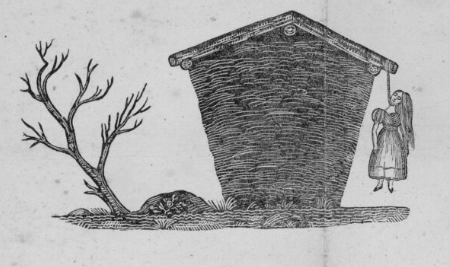
Illustration from a pamphlet with a ballad about Sarah Cornell’s murder. c1833
The subsequent investigation and examination, however, pointed toward the Reverend Ephraim Kingsbury Avery, a married Methodist minister who had been serving in Bristol, Rhode Island, and who had known Cornell since approximately 1828. The allegation was that Avery had fathered her child during an encounter at a Methodist camp meeting in Thompson, Connecticut, in August 1832, and that when confronted with the prospect of scandal, he had arranged to meet Cornell at a local farm and killed her to preserve his reputation and his marriage. Letters found on her body and in her boarding room, believed to be in Avery's hand, were central to the case against him.
Avery's trial opened in Newport, Rhode Island, in May of 1833. It lasted twenty-seven days, the longest criminal trial in New England history to that point, and it drew enormous public attention. The verdict, delivered on June 2, 1833, was not guilty.
The acquittal was not because the evidence was weak. It was because Avery’s defense made Sarah Cornell the defendant. His attorneys described her as, and I am quoting from the historical record here, "utterly abandoned, unprincipled, profligate." They called witnesses to testify to her supposed promiscuity, her mental instability, her history of suicidal ideation, and the fact that she had previously been expelled from the Methodist Church for fornication. The strategy was to make the jury believe that whatever happened to Sarah Cornell was something she had brought upon herself, and that the word of a respectable married minister of God was worth more than the physical evidence and the letters. And it worked.
The public response was furious: effigies of Avery were burned, and there was at least one attempted lynching in Boston. But he was free, and Sarah Cornell had been buried twice, once in the ground and once in the courtroom (The National Library of Medicine, 1833; Kasserman, 1986).
The Parallels Are Not Subtle
I want to be careful here not to ignore the genuine differences between these cases. They occurred in different centuries, under different legal systems, with different standards of evidence and different institutional actors. Sandra Birchmore's case was ultimately a federal prosecution, with the FBI doing the work that local authorities failed to do. Matthew Farwell was convicted. These are not minor distinctions.
But the structural similarities are striking enough that I think they are worth naming, because I do not think they are coincidental. I think they reflect something persistent about how communities, legal systems, and public opinion respond when a man with institutional power kills a vulnerable woman he abused to protect himself from scandal.
In both cases, the victim was a younger woman whose connection to the perpetrator was mediated by an institution that was supposed to protect her. For Sarah Cornell, that institution was the Methodist Church. For Sandra Birchmore, it was a police youth program. In both cases, the man who killed her had a great deal to lose from her continued existence: Avery his ministerial career and his marriage, Farwell his freedom and his professional standing. In both cases the death was initially interpreted as a suicide, with accusations that the body was staged to cover a murder. In both cases, the defense strategy turned on attacking the victim's character, her mental health and suicidality, her sexual history, and her moral credibility. And in both cases, the community could not stop watching.
The character attacks on Sandra Birchmore during the Farwell trial were perhaps less baroque than the language used against Sarah Cornell in 1833, but they were functionally identical in purpose. Farwell's defense described Sandra as volatile and troubled, as someone whose mental health history made suicide a plausible explanation, as a young woman whose difficult circumstances were essentially her own problem. The defense was asking the jury to look at a woman who had been groomed as a child by a man in authority over her and to find in her history of struggle evidence that she had, in some meaningful sense, done this to herself. It is the same argument made in a different century with more careful vocabulary.
Southern New England: True Crime Hotspot?
There is one more thing I want to note, which I find both interesting and a little uncomfortable. This is the third high-profile criminal case in a relatively small geographic corridor of southeastern Massachusetts and Rhode Island to draw enormous national attention in the last few years. Karen Read's trial, the Lindsay Clancy case, and now the Farwell verdict have all occurred within a fairly tight radius of one another and have all attracted the kind of heavy true crime media attention that transforms local legal proceedings into national spectacles.
I do not think there is anything special about this region that makes it unusually prone to serious crime. I think what is happening is that once an area develops a reputation as a locus of dramatic, legally contested, true crime-adjacent cases, the media attention becomes self-reinforcing. Journalists are already in the area. Podcasters have already built audiences around one case and are looking for the next one. Online communities that formed around Karen Reed transferred their energy and their attention to Clancy, and then to Birchmore. That is worth noticing, because media attention has real effects on how cases are tried and how victims are perceived. The public discourse around Sandra Birchmore was not always kind to her, and some of the loudest voices online were more interested in the scandal involving a police officer than in the person who was killed (Bonn, 2014).
My thoughts are with Sandra's family. With her cousin Barbara Wright, who has been her most visible public advocate throughout this process. And with Sandra herself, who was failed by multiple institutions and multiple adults who were supposed to protect her, and who deserved a great deal better than what she got, in life and in the years it took to get here.
And my thoughts are with Sarah Cornell too, two centuries on. Some things take longer than they should.
References
Bonn, S. A. (2014). Why we love serial killers: The curious appeal of the world's most savage murderers. Skyhorse Publishing.
Kasserman, D. R. (1986). Fall River outrage: Life, murder, and justice in early industrial New England. University of Pennsylvania Press.
National Institute of Justice. (2010). Overview of rape and sexual violence. U.S. Department of Justice.
The National Library of Medicine. The trial of the Rev. Ephraim K. Avery, for the murder of Sarah Maria Cornell. The National Library of Medicine http://resource.nlm.nih.gov/101220897
WBUR News. (2026, November 10). Jury finds Matthew Farwell guilty of killing Sandra Birchmore and unborn child. WBUR. https://www.wbur.org/news/2026/11/10/guilty-verdict-matthew-farwell-sandra-birchmore
