Psychology at the Movies: Rob Zombie's Halloween (2007)
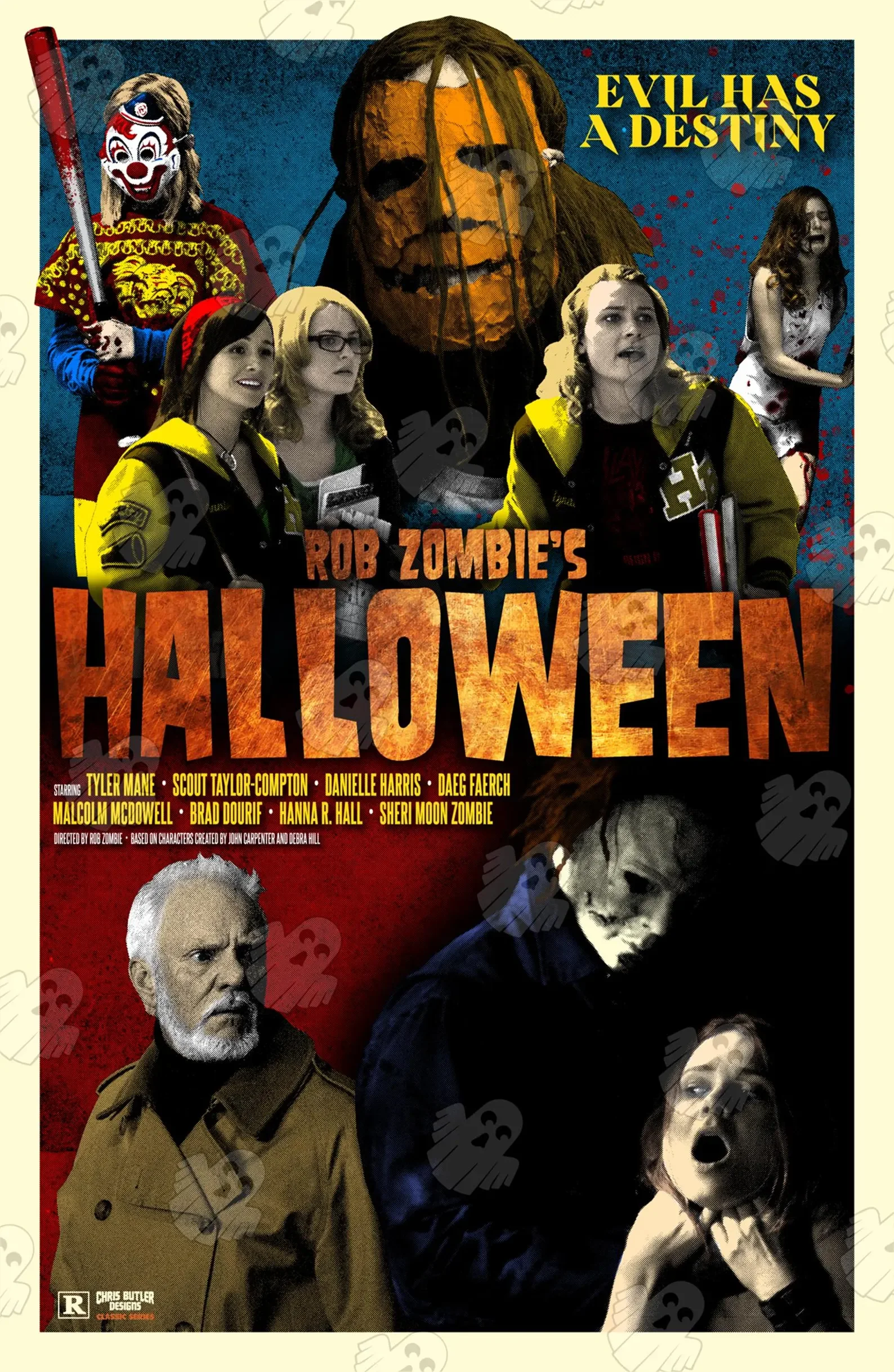
I’ve been wanting to do a movie post for a while, but things have been busy elsewhere. However Halloween is almost here and, tis the season, I think it’s fitting to do one and that this one is going to be a Halloween movie in the most literal sense possible: we are talking about Rob Zombie's Halloween, the 2007 reboot. I am saving the original 1978 Carpenter film for another time, but Zombie's version has been rattling around in my head for years and I think it is worth pulling apart from a psychological perspective. The movie is, in many ways, a mess. But it is a mess with some genuinely interesting things buried inside it, and it’s largely better than half the Halloween movies in that series (though there’s no Busta Rhymes in this one).
A Little Context
Rob Zombie is best known as a heavy metal musician and as a director with a very specific aesthetic: grimy, grotesque, grindhouse-adjacent horror that tends to be loud and overwhelming and over the top. His Halloween came out in August 2007 and was positioned as a franchise reboot after a run of increasingly weak sequels had basically run the series into the ground. There was genuine enthusiasm about what he would do with the property. He is nothing if not a committed artist, and the idea of giving a genuinely transgressive filmmaker the keys to one of horror's most iconic characters was exciting.
I did not rush out to see it in theatres. But a friend of mine did, and he came back very excited. He thought that I, who had just started my graduate studies in forensics, would love that the film was remarkable because of how much it focused on the human elements of psychopathy. So I went. I watched it. And I came out, to everyone's surprise, somewhat disappointed.
Much of my disappointment was aesthetic. A lot of what makes the original Halloween work is atmosphere and restraint, and Zombie is categorically incapable of restraint---which I love in music but not necessarily in cerebral horror. The movie is loud and brutal and relentless in a way that undercuts the creepiness that made the original so effective. But beyond that, there is something genuinely frustrating about a film that gestures toward serious psychological themes and then abandons them in favor of spectacle. I am going to try to rescue the interesting parts here, because they are worth engaging with seriously, even if the film itself does not always earn that engagement.
One quick practical note: there are multiple versions of this movie floating around, including a theatrical cut and a director's cut with substantially different material. I’ve seen both repeatedly, and the story about how I inadvertently showed the Director’s Cut on a date without realizing it is a story in and of itself. But, my strong recommendation, if you want to watch this one, is to start with the theatrical release. And then maybe splice in scenes of the Director’s Cut in your headcannon. I think somewhere between these two films, there’s one halfway decent one, but it requires more work to find it.
Michael Myers, Adverse Childhood Experiences, and the Origins of Violence
The most significant structural choice Zombie makes in this film is to expand Michael Myers's origin story dramatically. In the original 1978 movie, the young Michael appears for maybe two minutes before the opening credits, and what we see is deliberately stripped of context. A six-year-old boy in a clown costume has just murdered his sister. The horror comes precisely from the absence of explanation. Zombie goes in exactly the opposite direction: he devotes roughly the first twenty minutes of the film to Michael's childhood, and he loads that childhood with every indicator of developmental trauma ever imagined.
The Myers household is a portrait of compounding dysfunction. Michael's mother is involved with a brutally abusive boyfriend. There are strong suggestions of physical abuse directed at multiple family members and hints of sexual abuse directed at Michael's older sister Judith. Michael himself is being victimized by bullies at school. And somewhere in the middle of all this, he has begun harming animals, which the film presents as an early warning sign of something darker developing underneath.
On Halloween, Michael brutally kills his bully, his mother's boyfriend, and his older sister and her boyfriend. And then the film jumps forward in time, and we follow his institutionalization and eventual escape, which is, more or less, the plot of every other Halloween movie.
The developmental picture Zombie is painting here maps, quite intentionally, onto what researchers have come to understand about adverse childhood experiences and their relationship to later violence. The ACE framework, developed from the landmark 1998 Felitti et al. study, documents the cumulative effects of childhood trauma including abuse, neglect, household dysfunction, and exposure to domestic violence on long-term physical and psychological health outcomes (Felitti et al., 1998). Subsequent research has built on this substantially. There is a meaningful body of evidence suggesting that exposure to multiple, compounding adverse experiences in early childhood is associated with increased risk for a range of negative outcomes, including further victimization and early death, but aggression and violent behavior later in life (Baglivio et al., 2014). The latter is vastly more common, but the former makes for better horror movies I guess.
Cruelty to animals in childhood is particularly notable in this context. Sometimes called one leg of the "homicidal triad" (along with bedwetting and fire-setting), animal cruelty has been examined as a potential early indicator of later antisocial and violent behavior, and it appears with notable frequency in the developmental histories of individuals who go on to commit serious acts of violence, including some of the most well-documented serial offenders in the forensic literature (Tallichet & Hensley, 2002). Zombie makes sure to foreground this detail prominently, and while the overall picture he paints is cartoonishly over-determined, the individual elements he reaches for are not random.
Here is where I want to be careful, because this is a point the film itself does not handle particularly well: early childhood trauma and abuse do not automatically produce violent adults. They simply do not. The relationship is correlational, not causal, and it is important to say this plainly: the vast majority of people that experience violence and abuse in their childhood do not go on to become abusers themselves, and treating violence as a victim’s destiny is both empirically wrong and deeply unfair to survivors. The point is not that abuse makes people abusive. The point is that when we look backward at the histories of individuals who did go on to commit serious violence, adverse childhood experiences are present with striking frequency. That is a risk factor conversation, not a deterministic one. Zombie, to his credit, seems to be gesturing at this idea, but the film's insistence on piling every possible trauma onto a single character makes it feel less like a nuanced developmental portrait and more like a checklist.
What the Film Gets Wrong About Psychopathy
Once the origin story wraps up, the film runs into a fundamental problem that it never really solves: Michael Myers, as a cinematic creation, is not actually a psychopath in any clinically meaningful sense. He is a supernatural monster. And Zombie's attempt to graft a realistic psychological backstory onto a character who is ultimately defined by superhuman silence, size, and indestructibility creates a tension the film cannot resolve.
One of the things the film keeps returning to is the question of whether Michael is psychotic or simply psychopathic. When, as a child, he is questioned about the murders, he seems genuinely disconnected from what he has done, almost as if he does not register it as real. It’s possible that this is psychosis, where Michael is delusional, or this could be the feature of psychopathy where they refuse to take responsibility for their actions. This ambiguity is interesting.
Psychopathic individuals, as the research literature describes them, are typically highly verbal, socially skilled, and interpersonally manipulative. They tend to be charming in initial encounters. They lie fluently and adjust their presentation to their audience. What they lack is genuine empathy and any meaningful capacity for remorse. What they are not is mute, hulking, physically unstoppable, and entirely asocial (Hare, 1993). The version of Michael Myers that Zombie presents is closer to a force of nature than a person, and the psychological framework the first act works hard to establish essentially evaporates once the slasher mechanics take over.
For me, most significantly, is that Michael appears to genuinely love his mother and baby sister. “The Sister” theme of the majority of the Halloween films (not the first notably…) is that Michael is actively trying to kill his younger sister and is chasing her through the films killing any that get in his way. In this film, it’s ambiguous. He’s clearly trying to find her and leaves a cartoonish amount of death in his wake. But it appears that he wants to connect with her or possibly save her from what he remembers as trauma, not hurt her. And that is not psychopathy. Psychopaths aren’t misunderstood monsters like Frankenstein’s monster (the creation, Dr. Frankenstein actually was a monster).
This is not a criticism unique to Zombie's film. It applies to the entire franchise and to most cinematic portrayals of this type of character. Horror has always found the idea of the psychopath useful as a shorthand for incomprehensible evil, but the shorthand is deeply inaccurate, and I think it does real harm by making psychopathy feel monstrous and alien when the actual clinical picture is considerably more mundane and, in some ways, considerably more frightening because of how recognizable it can be.
Smith's Grove and the Real History of Psychiatric Warehousing
One of the places where I think Zombie's film does something genuinely worth engaging with is its portrayal of Smith's Grove Sanitarium, the psychiatric institution where Michael is held for fifteen years between the murders and his escape. In the original Halloween films, Smith's Grove is presented as an imposing but not especially sinister place: a large institutional facility where Michael exists more or less quietly under the care of Dr. Loomis. Zombie's version transforms it into something much darker.
The Smith's Grove in this film is a house of horrors. The staff are abusive and brutal. Violence against patients is casual and routine. The institution is understaffed, underfunded, and operating in a state of constant degradation. Michael's decades there are, by implication, a prolonged ordeal of dehumanization.
This is, as with the origin story, extremely over the top. But it is not entirely without historical basis. The history of psychiatric institutionalization in the United States is genuinely grim. The asylum movement of the nineteenth century was, in its original conception, well-intentioned: reformers like Dorothea Dix argued passionately that individuals with serious mental illness deserved humane care in dedicated facilities rather than incarceration in prisons or poorhouses. The institutions that resulted from these efforts were often architecturally impressive and positioned as places of treatment and refuge.
What happened in practice was familiar institutional failure. Asylums became chronically overcrowded and dramatically underfunded. Staff-to-patient ratios made genuine care impossible. Patients were warehoused rather than treated. Abuse, neglect, and physical brutality became endemic. Facilities like Danvers State Hospital in Massachusetts, which opened in 1878 and was one of the most architecturally celebrated of the Kirkbride-plan hospitals, became bywords for institutional horror well before they were officially closed and demolished. The process of deinstitutionalization that began in earnest in the 1950s and accelerated through the 1970s was, in part, a response to documented conditions inside these facilities that were genuinely unconscionable (Torrey, 1997).
Zombie's Smith's Grove is a fever-dream version of this history, played at maximum volume. But when Michael's institutionalization turns him into something worse than he was, rather than rehabilitating him, the film is at least gesturing at a real critique: that institutions designed to treat and protect people with serious mental illness have a long and well-documented history of doing exactly the opposite.
Dr. Loomis, Pop Psychology, and the Celebrity Clinician
The character of Dr. Sam Loomis, Michael Myers's psychiatrist, is one of the more durable archetypes in the franchise. In the original films, Loomis, played by Donald Pleasence, is a haunted, obsessive figure who understands something true and terrible about what Michael is and spends his career trying to warn people who will not listen. I feel that, in the Carpenter films, he is a genuinely tragic character.
Zombie's version, played by Malcolm McDowell (of A Clockwork Orange fame), is something quite different. We first meet this Loomis when Michael is a child, and the presentation is immediately striking. He shows up to speak with school administrators about the disturbing behavior of this young patient wearing large sunglasses, dressed casually, and radiating a kind of breezy self-confidence that reads as profoundly inappropriate for the situation. I found myself thinking, watching that scene, of Philip Zimbardo of the Stanford Prison Experiment. Dr. Zimbardo dressed similarly in interviews, and was well known for an unconventional style in presentations. He certainly wasn’t slimy like Loomis’s character, but I do not think the comparison is entirely accidental on Zombie's part.
As the film moves forward in time, we learn that Loomis has built his entire career around Michael's case. He has written books about it. He gives lectures. He has become something of a celebrity in the psychological and true crime adjacent world, profiting substantially from his association with the most famous patient he ever had. By the time we reach the main timeline of the film, Loomis has essentially become a pop psychologist: someone whose professional identity has migrated from rigorous clinical practice toward public performance and monetization.
This is a genuinely interesting critique, and it maps onto something real. There are many prominent researchers and clinicians parlaying their legitimate academic work into public celebrity, sometimes in ways that serve the public and sometimes in ways that primarily serve the clinician. Figures like Robert Hare, whose work on psychopathy has been enormously influential and important in the field, have also become touchstones in popular culture, with their frameworks applied in ways that sometimes diverge significantly from the original research (Hare, 1993). The broader ecosystem of clinical-celebrity, from the obvious examples like Dr. Phil to the current wave of psychology content creators on social media, has its own complicated relationship with accuracy and rigor that I find fascinating and occasionally alarming.
What McDowell brings to the role is a kind of preening self-satisfaction that makes Loomis genuinely uncomfortable to watch. He is clearly intelligent. He clearly understands something about Michael. But his primary interest seems to be in what Michael's case can do for him, rather than in what it might mean for Michael or for the people Michael will eventually harm. It is a different kind of horror than anything the slasher elements provide.
Closing Thoughts
Rob Zombie's Halloween is not a great movie. If you are looking for the atmosphere and slow-burn dread of the original, you will not find it here. What you will find is a film that, buried under all the gratuitous violence and maximalist excess, has something worth saying about adverse childhood experiences and developmental trauma, about the institutional failures of psychiatric warehousing, and about the uncomfortable relationship between clinical expertise and public celebrity.
The psychopathy framing ultimately does not hold up, because Michael Myers cannot be a psychopath and also a mute supernatural monster looking to protect his sister at the same time, and Zombie wants him to be both. But the film's first act is doing something more interesting than most slasher movies attempt, and its version of Dr. Loomis is a character study that has stuck with me for years.
If you are looking for Halloween viewing this season and you have already seen the 1978 original more times than you can count, just go watch it again. But, if you want something new, this one is worth a watch. Go with the theatrical cut. The director's cut contains a better film in places, but finding it requires sitting through considerably more splatter than most people need on a Saturday night in late October. Trick or treat.
References
Baglivio, M. T., Epps, N., Swartz, K., Huq, M. S., Sheer, A., & Hardt, N. S. (2014). The prevalence of adverse childhood experiences (ACE) in the lives of juvenile offenders. Journal of Juvenile Justice, 3(2), 1-23.
Felitti, V. J., Anda, R. F., Nordenberg, D., Williamson, D. F., Spitz, A. M., Edwards, V., Koss, M. P., & Marks, J. S. (1998). Relationship of childhood abuse and household dysfunction to many of the leading causes of death in adults: The Adverse Childhood Experiences (ACE) Study. American Journal of Preventive Medicine, 14(4), 245-258.
Hare, R. D. (1993). Without conscience: The disturbing world of the psychopaths among us. Pocket Books.
Tallichet, S. E., & Hensley, C. (2002). Exploring the link between recurrent acts of childhood and adolescent animal cruelty and subsequent violent crime. Criminal Justice Review, 27(2), 304-316.
Torrey, E. F. (1997). Out of the shadows: Confronting America's mental illness crisis. John Wiley & Sons.
Zombie, R. (Director). (2007). Halloween [Film]. Dimension Films.
